
.jpg)
One of the most rewarding and anticipated moments for custom homeowners is walking through the finished home for the first time. Naturally, one of the first questions homeowners ask is how long it will take to see their home completed. This guide walks through how long the building process generally takes, what factors shape that timeline, and how we manage it once construction begins.
Building a custom home typically takes about 13 to 18 months from your first meeting with us to the day you receive your keys. That figure covers two distinct phases: pre-construction and construction.
Pre-construction is where we plan before breaking ground: architecture, interior design, selections, engineering, and permitting. Pre-construction typically takes 4–6 months. For clients who want more time to refine their vision and finalize selections, it can extend to 6–9 months. The timeline moves at the pace that's right for you — the clearer your vision going in, the faster we're able to break ground. We do not rush this phase, because the work done here is what protects the schedule once building starts.
Construction of a custom home typically takes nine to twelve months from the first day of foundation work. Homes with simpler designs may finish closer to nine months, while more intricate architecture, custom finishes, or challenging site conditions can extend a project closer to twelve.
Pro tip: For a full walkthrough of the entire building journey, from your first consultation through pre-construction, construction, closing day, and the warranty support that continues after you move in, see Rivendale's Custom Home Building Process: From First Contact to Move-In.
Several factors can affect a custom home schedule: local permitting requirements, site conditions, how soon selections are completed, material availability, change orders, and Austin's weather. Understanding these early gives you visibility into what to expect once you commit to building, and if your schedule does shift, the context to understand why and what it means for the rest of the project.
Before we submit plans for permitting, we assess the property for conditions that may affect the review process, including heritage trees, impervious cover limits, slope, floodplain and watershed boundaries, and Wildland-Urban Interface requirements tied to wildfire risk. These conditions can introduce additional design requirements or layers of municipal review, which can influence how long permitting takes.
The City of Austin’s initial review runs about ten business days, but most projects require at least one correction cycle, bringing the total review period to several weeks or a few months (City of Austin Development Services Department, 2026). Additional requirements can extend that timeline further. Heritage tree review and watershed overlays, for example, can each add several weeks to the permitting process (Davis Agency, 2026).
That is why local permitting experience matters. At Rivendale, a permitting specialist manages this process for each project, using years of experience with Austin’s requirements to identify potential constraints early, coordinate required documentation, and help keep permitting moving toward the anticipated construction schedule.
Site conditions of your lot can directly affect how long construction takes. Slope and soil conditions are two of the biggest factors. Steeper lots often require more grading, retaining work, and a more complex foundation, which can add time early in the build.
Soil conditions matter because they determine how the foundation needs to be engineered. Much of Central Texas sits on expansive clay and shallow limestone, so we complete geotechnical soil testing before construction begins to understand what is below the surface and finalize the right foundation approach for the site.
A relatively flat lot with straightforward soil conditions typically allows for a more predictable start to construction. A hillside lot may require additional site preparation and engineering before the home begins taking shape above ground.
Selections typically take four to six months to complete, and the pace at which you finalize them has a direct effect on your construction schedule. Each material needs to be selected before it can be priced, ordered, delivered, and installed, so the timing of these decisions shapes when each phase of construction can begin. Finalizing decisions early protects your timeline: a selection made later in the process can lead to delays, from ordering to installation.
That is why close to 90% of these decisions are made during pre-construction at Rivendale. Our interior designer works with you throughout this process, pacing each decision against the construction schedule so your timeline stays protected while still providing you the time to make thoughtful, personalized choices for your home.
Material lead times can affect the construction schedule, especially for custom or specialty items that require longer manufacturing or delivery periods. Our purchasing team tracks availability during pre-construction and prioritizes long-lead selections early so materials can be ordered in time for the trades scheduled to install them.
Occasionally, a selected material may become back-ordered or discontinued. If a reselection is necessary, that process can add days to the overall schedule while a new option is reviewed, approved, ordered, and delivered. We guide you through reselections with alternatives that remain aligned with the design of your home while keeping the schedule moving as efficiently as possible.
It's not uncommon for homeowners to want to make changes during construction. However, change orders can lead to delays. Even a seemingly small adjustment, such as upgrading to natural stone countertops or adding custom millwork, may require revised plans, additional time to source new materials, updated pricing, or changes to work already scheduled with trade partners.
Nevertheless, we welcome your input should you decide to make a change. Our team outlines the potential cost and schedule implications before work proceeds, so you can make an informed decision with a clear understanding of how that change may affect your timeline.
Austin's weather can be unpredictable at times. Inclement weather can lead to unavoidable delays in the construction schedule. In fact, OSHA and NOAA (the federal agencies responsible for workplace safety and national weather tracking) require construction teams to stop outdoor work the moment lightning is present, since trades working on ladders and metal roofing near electrical systems face a genuine safety risk (Occupational Safety and Health Administration & National Weather Service, 2016). Heavy rain and, less often, winter freezes can also push back site work, foundation pours, and exterior work by days at a time.
Understanding what influences a custom-home timeline is only part of the picture. The way those variables are managed throughout the project ultimately shapes how consistently construction progresses. At Rivendale, our process coordinates decisions, purchasing, trade partners, quality control, and homeowner communication around a project-specific schedule. For you, that means more consistent progress, greater visibility throughout construction, and the time and coordination necessary to protect the craftsmanship and design intent of your home.
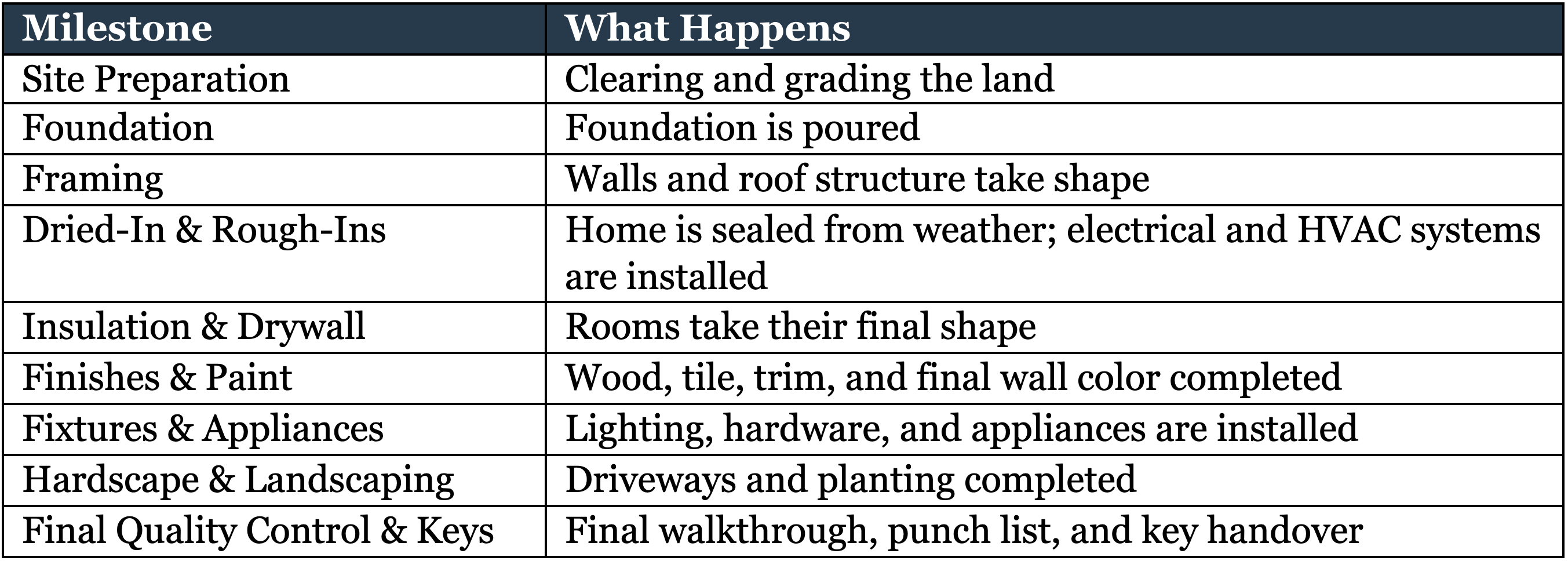
Within days of your transition into construction, our team finalizes a schedule tailored to your home’s scope and complexity, with major milestones mapped from foundation and framing through mechanical rough-ins, finishes, quality control, and handover. Our experience across a substantial portfolio of custom homes gives us current scheduling data to inform each project timeline. Decision deadlines, purchasing, and trade sequencing are then coordinated against that schedule so the work can continue progressing toward your anticipated completion date.
A well-managed schedule also gives each phase of construction the time and coordination required to meet our high quality standards. Every Rivendale home is reviewed against nearly 1,000 quality checkpoints organized by trade, allowing our project managers to inspect completed work before subsequent phases move forward. Identifying an issue at this stage protects both the craftsmanship of your home and the schedule itself, since rework later in the process costs time.
You receive a milestone-based schedule at the start of construction so you can see how the project is expected to progress toward completion. Throughout the build, we provide regular updates through site walks, photos, videos, and direct communication. If weather, permitting, material availability, or another factor affects the schedule, our team explains what changed, which milestone is affected, and what to expect next.
Does a larger custom home always take longer to build?
Not necessarily, and size alone is not the best predictor. The factors listed above, such as site conditions, tend to influence the timeline more than square footage. A 4,000-square-foot home on a flat lot can move faster than a similarly sized home on a steep site.
When should I start planning around my expected move-in date?
It depends on what you're planning for. As a general rule of thumb, electrical power is turned on in the home about 45 days before key handover, which is a reliable signal that your move-in date is close and a good trigger point for near-term logistics like furniture delivery, hiring movers, and transferring utilities and homeowners insurance. Longer lead-time items, such as selling your current home or ending a lease, should be planned further in advance, since those processes often take months on their own.
Can I make design decisions after construction has already started?
Yes. Homeowners sometimes decide to make changes during construction. The timing matters, since later decisions can affect material ordering, trade coordination, and later phases of construction. Rivendale explains the potential schedule and cost implications of any change before the work proceeds. Additionally, change-order process details are also outlined in your building contract. For a full breakdown of what that contract should cover, see 20 Key Items Every Custom Home Building Contract Should Include.
What happens if my custom home finishes earlier or later than the original projected date?
A custom-home schedule is a projection based on your home's scope, site, and selections at the time construction begins. As the project progresses, individual milestones may shift, but our team works to keep the overall completion date within the anticipated nine-to-twelve-month construction window. Progress is tracked against predicted-versus-actual updates each month, which allows our team to flag schedule shifts as soon as they happen, well before the final walkthrough. You'll always receive an updated picture of where the project stands and what any change means for your completion date.
A realistic timeline starts with your first conversation with us. When you contact Rivendale Homes, we walk your site, talk through your vision, and explain what your timeline would look like, so you know what to expect from the first meeting to the day you receive your keys.
Ben Goudy serves as Vice President of Operations for Rivendale Homes, where he oversees the full lifecycle of residential development—from land acquisition and feasibility studies to permitting, and client coordination.
Ben is an expert in Austin’s residential zoning requirements, tree regulations, and permitting processes. Over the years, he has built strong working relationships with City of Austin staff and has successfully applied for and obtained hundreds of building permits across the city. His extensive experience in lot analysis allows him to evaluate site constraints, identify opportunities, and understand how factors such as slope, trees, and impervious cover limits affect both design and cost.
Originally from California, Ben began his career in real estate in 2006 and joined a small investment firm in 2011, where he helped identify, acquire, and improve residential properties. After moving to Austin in 2014, he transitioned into custom homebuilding and has developed a deep understanding of how site conditions, code requirements, and market forces intersect in residential construction.
Outside of work, Ben lives in South Austin. He enjoys golf, gaming, and exploring Austin’s neighborhoods with his dog, Lucy—always keeping an eye out for the next great home site.