
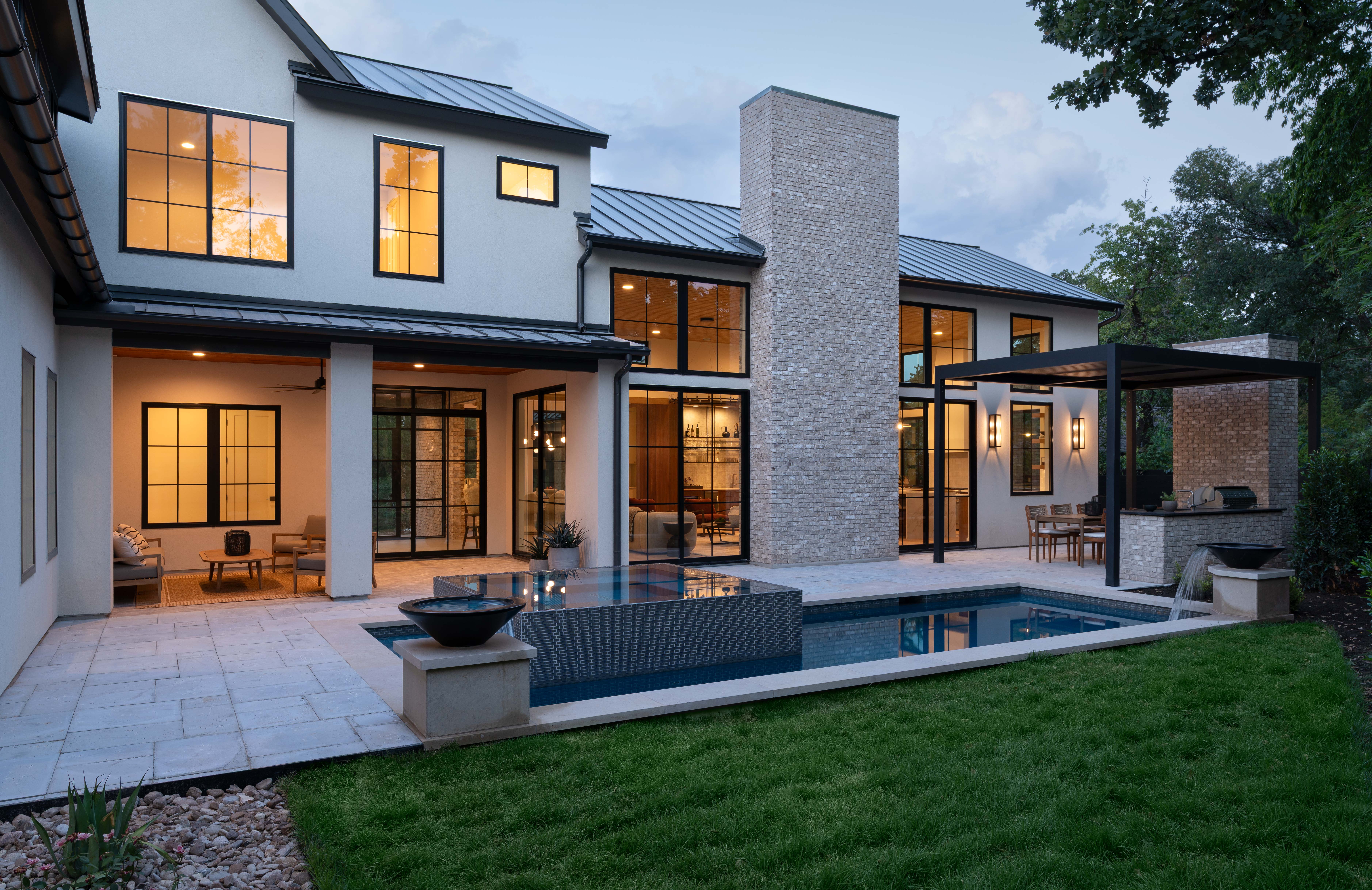
Most people choosing a custom home builder assume that a firm devoted solely to custom work is the natural choice. That assumption deserves a second look. A builder who also builds luxury spec homes invests its own capital in every one of them, and that discipline produces current cost knowledge, refined construction processes, and purchasing strength that carry directly into its custom work.
At Rivendale Homes, we build both. Our spec homes are not production houses. Each is an individually designed luxury home in one of Austin’s close-in neighborhoods, built with the same processes and to the same standards as our custom homes. Our custom clients typically build in the $2 million to $6 million range, excluding land.
One client purchased a lot with plans already drawn for a 4,238-square-foot home, only to find that every bid they received exceeded their budget. They had begun to doubt the home could be built at all. We delivered it with the high-end finishes they wanted, within their budget, and more than a month ahead of schedule.
These advantages matter most to homeowners who want exceptional craftsmanship and personalized design within a defined budget. If you are planning a highly specialized estate of $10 million or more, where cost management is a lesser priority, a builder who specializes in homes of that scale may be the better fit.
One of the biggest benefits of working with a builder who also builds spec homes is more competitive construction pricing. Because builders invest their own capital into these projects, they have to be especially mindful of construction costs, constantly securing competitive pricing for labor and quality materials, and keeping projects moving efficiently. These practices can bring valuable advantages to custom home clients while keeping the personalized design, craftsmanship, or details they desire.
At Rivendale Homes, one way we secure competitive construction pricing for our custom clients is through the competitive bidding practices we have developed across decades of building spec homes. We regularly compare prices from multiple qualified subcontractors and vendors to find the best value for the same scope of work or quality materials. For example, when hiring a framing subcontractor, we evaluate both their ability to meet our construction standards and the competitiveness of their pricing, rather than simply selecting the lowest bid. This approach is particularly valuable for labor-intensive trades like framing, electrical, and plumbing, where pricing differences can significantly affect the overall budget.
Additionally, building 10 to 12 spec homes each year also allows us to maintain strong relationships with subcontractors by providing them with a steady pipeline of projects to work on. These established relationships help us negotiate more competitive labor rates while maintaining the high construction standards our clients expect. Our membership in CBUSA, a builder purchasing group, also provides opportunities for discounts on certain materials through collective purchasing.
Construction costs can change throughout the year as material prices and subcontractor rates fluctuate. In fact, a July 2026 survey by the National Association of Home Builders found that builders reported a median 6.7% increase in material costs for the same home over the previous year (Emrath, 2026). This highlights why working with a builder who regularly purchases materials and hires subcontractors can be valuable. With prices constantly changing, builders who regularly purchase materials and hire subcontractors have more opportunities to stay informed about current construction costs instead of relying on pricing from older projects.
At Rivendale Homes, the number of homes we build annually gives us ongoing access to up-to-date pricing information for various aspects of construction, from framing and lumber to cabinetry, windows, and plumbing fixtures. We use that information to develop more accurate budgets and detailed cost breakdowns for our custom clients, giving them a clearer understanding of what their home will cost before committing to build with us. Having access to current pricing data also helps homeowners make more informed decisions about what material selections they should choose during pre-construction.
Our extensive experience building spec homes gives us regular opportunities to identify inefficiencies, such as wasted materials and unnecessary construction delays, and implement improvements to prevent them from recurring. Over 30 years of building nearly 1,000 homes, these incremental improvements have collectively strengthened our construction processes, helping us build more efficiently while maintaining the quality our clients expect.
One example is how we guide clients through material selections. Building so many homes has taught us that selections need to align with material lead times and the order of construction. A decision made too late can mean a material isn’t available when it’s time to install it.
That’s why our designer schedules selection meetings in the order materials are needed, starting with items that have the longest lead times. This gives clients time to consider their choices, such as the windows, cabinetry, tile, or plumbing fixtures they want, while helping our team order materials before installation to stay on track for the planned completion date.
We apply these same processes to every custom home. Each home is different, but the systems we’ve refined over the years help us coordinate subcontractors, maintain consistent quality standards, and keep construction moving efficiently without rushing clients through the important decisions.
Photos and renderings can give you a good idea of a builder's style, but walking through a home provides valuable insight that photos alone can't convey. Because of the number of spec homes we build, we regularly have completed homes and homes at different stages of construction that prospective clients can walk through. This allows our clients to get a much clearer sense of the craftsmanship, architectural details, and interior design, understand the scale of different spaces, and see how materials and finishes actually look, feel, and function once installed.
For example, clients have visited our Bunny Run home to get a feel for the scale of its spaces and decide whether features like its 22’ high ceilings suit the home they want to build. Walking through a completed home can also help them explore bigger-picture design choices, such as indoor-outdoor flow, in a way photos can’t. It’s also an opportunity to look more closely at finishes, fixtures, and appliance packages they might want to consider for their own home.
We’ve found that touring completed homes helps clients better understand their preferences, identify features they want to incorporate into their own homes, and make more confident decisions about their floor plans, materials, and finishes.
Yours. Our spec homes demonstrate the quality of our work; they are not a template for your home. Every custom home we build begins with your site, the way you want to live, and plans drawn by the architect you select. One client came to us with a lot and completed plans already in hand, and we built that home as drawn. To learn more about building a custom home with us, visit our custom homes page.
No. Custom homes are a distinct side of our business with their own leadership. Jesus Armendáriz, our Director of Custom Homes, is your primary contact from the first conversation through completion. Gama Cancino, our Vice President of Construction, oversees the construction of every custom home and is available to you directly for any construction question. Our long-term design partner, Dawn Hearn, meets with you personally and provides a calendar of selections built around material lead times, so that each decision is made in time to keep construction moving. We meet with you at every stage, and we take on no more than five custom homes at a time. Exceptional client service is at the core of what we do, and we structure our custom work to deliver it.
Yes. Our spec homes reflect what we choose to build, not the limit of what we can build. Custom clients have asked for saunas, wine rooms, elevators, specialty lighting, generators, and whole-home water filtration, and when a feature calls for a specialist beyond our regular trade partners, we bring one in and hold them to the same standards. Before you commit to any feature, we show you what it costs and how it affects the design and schedule, so that you can decide with complete information.
When construction begins, Gama Cancino, our Vice President of Construction, shares a milestone-based schedule covering each major phase from site preparation through key handover, with a day-to-day breakdown available if you want more detail. You will receive weekly or biweekly updates with photos, videos, and upcoming milestones, and we schedule site walkthroughs so you can see your home’s progress and ask questions along the way. Additionally, our team sends monthly reports comparing your budgeted construction costs with actual expenses, providing you with a transparent look into costs at every stage of the build.
You decide. It is your home, and our role is to advise, not to approve. We will tell you plainly what we think, including what a choice costs and how it affects function, appearance, or schedule. If we believe an elaborate millwork detail won’t return its cost, we will say so, and if you still want it, we build it. The rule is simple: if it meets code, fits your budget, and can be executed to our standard, it goes in your home. The only matters we cannot waive are structural integrity and waterproofing. If a window size or placement you want raises one of those concerns, we explain the issue and find a way to achieve the look within those standards.
We cannot promise that before seeing your plans, and you should be cautious of any builder who does. The cost of a custom home is driven chiefly by its design, its site, and the selections you make. What we can promise is that the pricing we secure reaches you. We build custom homes under a cost-plus contract, which means you pay the actual cost of labor and materials plus our fee. Your home is bid with the same trade partners we rely on for the homes we build with our own capital, and their pricing passes directly to you. The most reliable test is a direct comparison: bring us your plans, and we will prepare a detailed estimate you can set beside any other.
One of the best ways to decide whether a builder is right for you is to see their work in person. At Rivendale Homes, we invite you to tour one of our completed or in-progress homes, experience our craftsmanship firsthand, and get a better sense of what we could build for you. We are also happy to answer any questions you have about working with a builder who builds both spec and custom homes, discuss your vision, and help you determine whether we are the right fit for your custom home.
Schedule a Consultation to connect with our team and arrange a home tour.
Ben Goudy serves as Vice President of Operations, where he oversees the full lifecycle of residential development—from land acquisition and feasibility studies to permitting, and client coordination.
Ben is an expert in Austin’s residential zoning requirements, tree regulations, and permitting processes. Over the years, he has built strong working relationships with City of Austin staff and has successfully applied for and obtained hundreds of building permits across the city. His extensive experience in lot analysis allows him to evaluate site constraints, identify opportunities, and understand how factors such as slope, trees, and impervious cover limits affect both design and cost.
Originally from California, Ben began his career in real estate in 2006 and joined a small investment firm in 2011, where he helped identify, acquire, and improve residential properties. After moving to Austin in 2014, he transitioned into custom homebuilding and has developed a deep understanding of how site conditions, code requirements, and market forces intersect in residential construction.
Outside of work, Ben lives in South Austin. He enjoys golf, gaming, and exploring Austin’s neighborhoods with his dog, Lucy—always keeping an eye out for the next great home site.