

Most of our custom clients are building for the first time; some are building for the second or third. Either way, the final weeks before closing raise the same question: how do you know the home you are about to close on is the home you specified? The punch list process is the answer, and it works best when you understand not just the steps but the standard the home is being held to.
This guide covers what a punch list is, what counts as a defect, how a third-party inspection fits in, what happens at your homeowner orientation, how open items are closed, and what to expect after you move in.
A punch list is a written list of corrections, adjustments, and finishing work that must be addressed before the home is delivered. It is prepared at the homeowner orientation, documented by your project manager, and tracked until every item is closed.
One distinction is worth making before the walk. The punch list exists to deliver what was specified in your plans, selections, and contract. If a paint finish is uneven or a door does not latch, that is a punch list item. If you walk the finished home and decide you would prefer a different tile or a relocated outlet, that is a change order. Keeping the two separate protects your schedule and keeps the punch list focused on what it is for: correction, not redesign.
The distinction is easier to see side by side. The left column is what belongs on a punch list. The right column is what clients most often expect to be a punch list item but is, in fact, a change order.

If the home matches the plans, the selections, and the performance standard, and you would still like it to be different, that is a change order. We are glad to price one, and most are easier to do after closing than during the final week of construction.
Every Rivendale home is delivered under the Texas Association of Builders Express Limited Home Warranty and Performance Standards, which you sign at closing, with structural coverage extended to ten years under Rivendale’s separate structural warranty. The performance standards document is more than a warranty. It defines, in measurable terms, what a construction defect is. It is the standard your home is held to at the orientation, and it is the standard any dispute would be measured against afterward.
A few of the tolerances most frequently discussed during a walkthrough:
These are floors, not aspirations. They are the minimum a Texas builder is obligated to deliver, and our orientation is run against them. Knowing them before the walk makes you a better participant in it: you can see what is a legitimate item, what is within tolerance, and where a conversation is worth having.
Yes. A third-party inspection is optional unless your lender requires one, and we recommend it. A licensed inspector works from a checklist that is different from ours, operates every system, and produces a written report. The report becomes part of your closing file.
Here is how that works in practice. On a recent custom home, the client’s inspector delivered a repair list that ranged from exterior sealant and landscaping contact with siding to a reversed hot and cold supply line and pool gate hardware. Our team reviewed every item and signed a resolution document, before closing, committing to correct each one. That document references the inspector’s report page by page, and the client countersigned it. The inspection did what it is supposed to do, and the commitment to resolve it is in writing.
A few things worth knowing about how inspection items are handled:
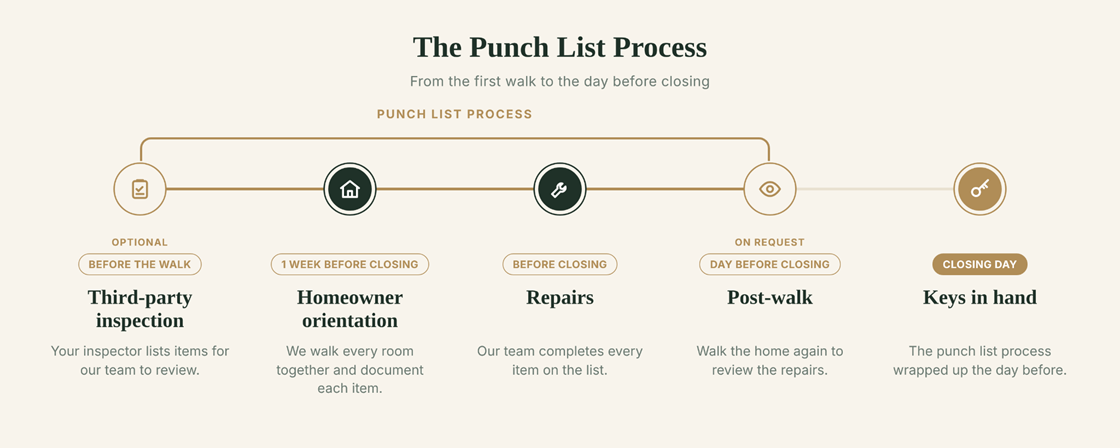
The homeowner orientation, sometimes called the final walkthrough or blue tape walkthrough, takes place about one week before closing. You, your agent, and your project manager walk the home room by room. The orientation has five parts.
Before anyone looks for imperfections, you learn how the home works. Your project manager walks you through the operation of:
Your project manager reviews the maintenance responsibilities that protect the home and affect your warranty coverage. In Austin, that conversation centers on the foundation: maintaining proper drainage away from the slab, keeping downspout diverters and irrigation working, and avoiding soil drying at the perimeter during summer. We also cover the importance of a steady indoor temperature year-round, and HVAC care: regular filter changes, keeping condensate drain lines clear, and, in the first two years, a service agreement with your original HVAC contractor with visits quarterly or every six months.
With the systems covered, you and your project manager revisit each room against the standards above. Cosmetic imperfections are marked with blue painter’s tape. Functional issues are recorded as you find them. On a recent custom home, the orientation produced fewer than ten items, each closed or documented before closing. Bring your inspector’s report, and bring your own list; the walk is thorough because you are part of it.
At the end of the walk, your project manager reviews every item with you, answers questions, and prepares the written punch list. You receive a copy. Our team then coordinates with the appropriate trades, and you are kept informed as items close.
Before you leave, we show you how to access our online warranty portal, submit a request, and attach photos, so that the process is familiar before you need it.
Our goal is to close every punch list item between the orientation and closing, typically within about a week. Throughout construction, we conduct daily quality control walkthroughs, identify deficiencies as they appear, and order replacement materials as early as possible so the punch list at orientation is as short as it can be.
Even so, a replacement part occasionally cannot arrive in time. On one of our builds, a replacement garage panel had a three-week lead time and could not be installed before closing. When that happens, the item is documented in an addendum at closing: a written commitment, in your closing paperwork, to complete the specific work. We then schedule the work around your availability, review open items weekly, and keep you updated until it is done.
Ask any builder how open items are documented at closing, and ask to see where that commitment is written.
Closing the list before closing on the home makes the transition from construction to living in the house a clean one.
After move-in, warranty requests are submitted through our online portal. Our 1-2-10 warranty provides one year of coverage for workmanship and materials, two years for plumbing, electrical, heating, and cooling delivery systems, and, under Rivendale’s separate structural warranty, ten years for qualifying structural components. Our team reviews each request, including the photos you submit, determines whether the item is covered, and coordinates the repair.
For more detail on coverage, see our Learning Center article on the Rivendale warranty.
The orientation is more useful when you arrive ready to use it. A few recommendations:
Before choosing a builder, ask how they handle the final walk, open items, and warranty requests. These questions separate a defined process from a well-meaning one:
Yes. Any item outstanding at closing is documented in a signed addendum. We schedule the remaining work around your availability and update you until it is complete.
Generally no, unless your lender requires it, but we recommend one. The inspector’s report is reviewed item by item, and our response is committed to in writing before closing.
Submit the request with photos through our warranty request page. We review the item against your warranty and coordinate any covered repair.
A punch list item corrects something that does not match the plans, selections, or performance standard. A change order is a request for something different from what was specified. Both are handled; they are simply handled on different paper.
A thorough final walkthrough means you move in knowing the home has been measured, room by room, against a standard you can read. If you would like to see how our process works for your project, call our sales team at (512) 865-5369 or schedule a consultation through our website.
Gamaliel “Gama” Cancino is the Vice President of Construction at Rivendale Homes Texas in Austin, where he oversees the delivery of the company’s luxury residential projects. He holds a Master’s in Construction Management and specializes in operations, Lean construction, and quality control.
Gama mentors Rivendale’s project managers, manages master schedules, coordinates with utility providers, and has been instrumental in developing the systems and training programs the construction team works from. He is driven by a commitment to building both exceptional homes and strong teams.
Beyond his professional life, Gama puts his faith in Jesus first, treasures time with his family, and enjoys the creative pursuit of making handcrafted soap.