
As a homebuyer, you shouldn't have to choose between quality, design, and a well-managed budget. A deliberate cost-management strategy can help keep construction costs competitive while protecting the craftsmanship and design standards you expect. At Rivendale, we manage construction costs through a series of systems that guide purchasing, sourcing, estimating, permitting, construction planning, and quality control throughout the build. Here's how each system works—and the difference it makes when you build with Rivendale.
Specialized Purchasing Team
At many custom home companies, the construction manager handles purchasing alongside scheduling and field supervision, and purchasing is managed as one responsibility among several competing priorities. At Rivendale, the purchasing department is a priority: it’s a four-person team, focused on materials, vendor contracts, bids, pricing, and delivery coordination.
Having a team dedicated to these responsibilities creates more opportunities to identify and control costs throughout the purchasing process. Our purchasing team negotiates scopes line by line, compares multiple bids in detail, and manages vendor relationships continuously. This oversight also lets the team address pricing before materials are ordered, when there's the most flexibility to reduce costs on the homeowner's behalf.
Trade and Vendor Relationships
Rivendale has cultivated long-standing relationships with leading local suppliers and trade partners throughout Austin. Our history in the market, reputation as a builder, and consistent business with these partners have made Rivendale a valued client for many of the vendors we work with.
Those relationships translate into cost advantages for our clients, with trade costs averaging about 10% lower. Long-term partnerships and ongoing business help us secure favorable pricing and terms from trusted vendors while maintaining the quality standards we expect for every home. We pass those savings on to you.
CBUSA Purchasing Programs
Our CBUSA membership, a network of 500+ independent builders, gives us national-level buying power, and it reaches the top of the market, not just the builder-grade middle. The same premium brands your home would call for regardless (Thermador, Andersen, Kohler, Cambria, Sherwin-Williams, GAF, James Hardie, Ferguson, DuPont) come without the markup most builders pass along. The membership also carries agreements with the top-tier local vendors who supply Austin's luxury builds. None of this changes what goes into your home; it changes what you pay for it.
Value Engineering
Sometimes a selection you love comes in over budget. Most builders give you two options: cut it, or absorb the overage. We offer a third. Because we know the products and the trades deeply, we can often find a path to the same design intent, the same look, the same performance, at a number that fits. That might be the identical aesthetic from a different manufacturer, or a small change to a custom element that the eye will never catch but the budget will feel. One client had their heart set on Brazilian hardwood floors. We sourced an alternative that matched the look and the performance at roughly half the cost. You're never choosing between your vision and your budget. Our job is to protect both.
Direct Purchasing and Labor-Only Subcontractors
Many builders hire subcontractors for both labor and materials. When a subcontractor supplies both, they may add a markup of 20% or more on the materials portion, since they're taking on the cost and risk of sourcing.
We manage our own material procurement across our trades, from framing to flooring and painting, and hire subcontractors solely for labor. This removes the subcontractor's material markup entirely, producing roughly 10% in savings.
In-House Pool Construction
Pools can represent a significant line item in a luxury Austin build. In-ground pools in Austin typically cost about $90,000, with larger and more customized designs reaching higher price points. We build pools in-house, which eliminates the third-party markup a specialty pool subcontractor would otherwise add. That structure delivers up to 20% lower pool costs for our clients.
Securing a competitive price on materials is only part of controlling construction costs. Another crucial step is knowing the exact amount of material that is needed—nothing more, nothing less—at every stage of construction. Our expert estimating abilities prevent over-ordering, which means paying for unused material, as well as under-ordering, which can cause delays and added costs when shortages have to be sourced. When materials run short, missing quantities may need to be sourced quickly, potentially resulting in rush delivery fees or higher material prices.
Austin and its surrounding jurisdictions each have their own permitting processes and local requirements. Those requirements can include rules on utilities, tree protection, impervious cover limits, drainage, and, where applicable, Wildland Urban Interface (WUI) requirements for lots in designated wildfire risk zones.
Because our permitting specialist deeply understands local jurisdiction requirements, their expertise helps move permits through city review efficiently so construction can begin sooner. Timely permitting is important because delays can create downstream disruptions to material deliveries, vendor schedules, and the overall construction timeline—all of which can increase carrying costs and delay the completion of your home. Their expertise also helps the team account for jurisdiction-specific requirements early. For example, a lot within a designated WUI area may require specific roofing materials or minimum clearances around the home. Identifying those requirements during design allows them to be incorporated into the plans before permit submission, helping avoid revisions and additional review that could delay the project.
Builders who apply lean construction principles, a discipline built around identifying and eliminating waste during construction, are positioned to avoid cost overruns, project delays, and quality issues. In a construction context, waste means any activity, material, wait time, or movement that doesn't add value to the finished home. Every one of those has a cost attached to it, like material purchased but never installed, or rework required to correct an error.
To put these principles into practice, we have operated a formal lean program for more than four years and implemented approximately 20 initiatives across estimating, purchasing, scheduling, material handling, and administrative work. Together, these initiatives have reduced construction costs by an estimated 15–25% by targeting inefficiencies and waste that can add unnecessary expenses throughout the building process. Those savings ultimately help us keep construction costs lower for our clients.
We manage quality control by setting a series of consistent checkpoints throughout construction. Our construction team follows a comprehensive quality-control checklist with close to 1,000 checkpoints, allowing our team to identify and address issues before subsequent work makes them more costly to correct. This level of oversight helps ensure that every stage of construction meets our high standards for quality and craftsmanship while preventing avoidable rework and the additional costs that come with it.
Why Ongoing Quality Control Matters
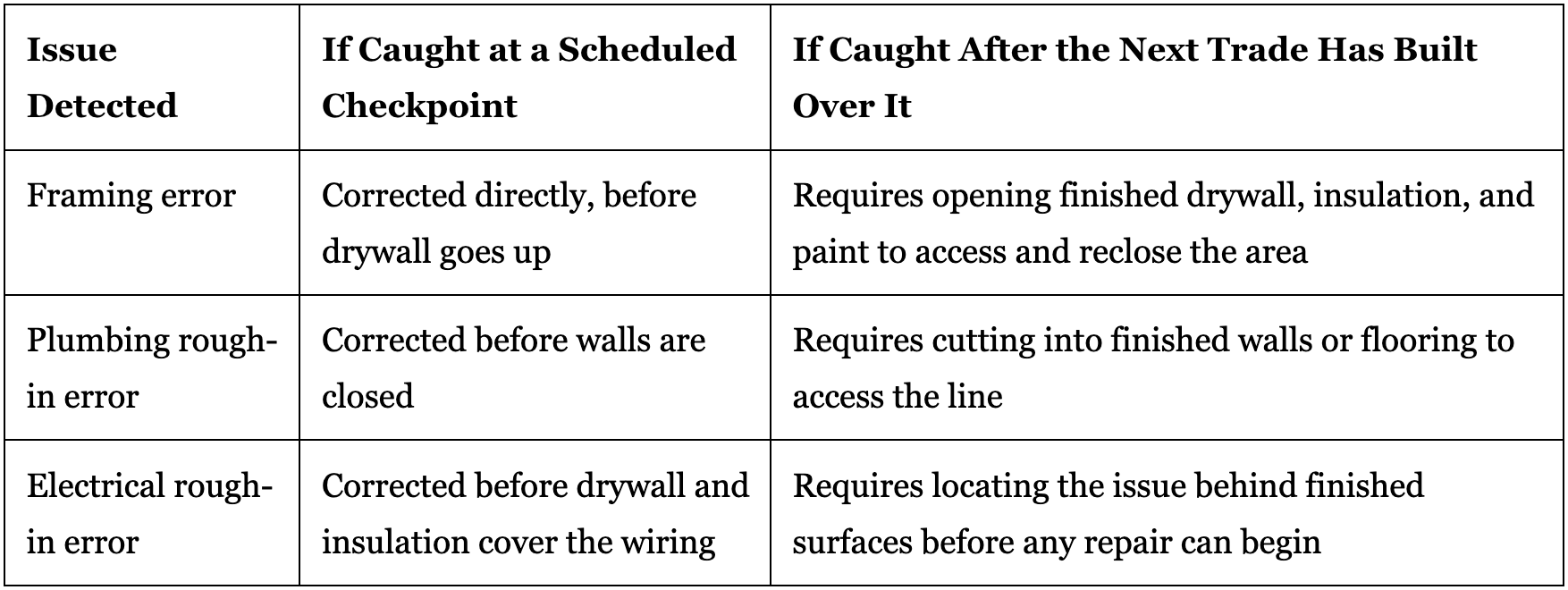
No single practice determines the final cost of a custom home. A strong purchasing team has limited impact if the estimate behind its orders is inaccurate. Lean construction cannot save time or money if permitting delays stall the project before construction begins. The value of these six systems comes from how they work together throughout the build. Purchasing power helps secure favorable pricing and identify opportunities for better value; smart sourcing reduces unnecessary markups; accurate estimating controls material quantities; permitting expertise helps construction start sooner and prevents avoidable revisions; lean construction targets waste throughout the building process; and ongoing quality control helps detect issues before they lead to costly rework. Together, these systems allow us to manage construction costs at multiple points while maintaining the quality and craftsmanship of the finished home. Our disciplined approach to cost management and the systems we have developed over time produce measurable results. When clients bring us quotes from other builders, we can often deliver comparable or higher-quality construction for 10–15% less. These results demonstrate the cumulative impact of managing cost deliberately at every stage of the building process.
Does a lower construction cost mean a lower level of quality?
No. The systems described in this article, purchasing, estimating, vendor relationships, and quality control among them, are designed to manage cost without changing the quality of the specifications, materials, or craftsmanship standard for a given home.
How do we communicate budget changes during construction?
Clients receive a monthly job cost summary during construction, showing the original budget, any changes recorded since the previous update, and the running total.
At what stage of pre-construction are there the most opportunities to control costs?
Interior design and selections offer significant opportunities to manage the construction budget because materials and finishes are available across a wide range of price points, with Level 6 being the most costly. Our interior designer guides clients through these decisions, identifying opportunities to value engineer selections when needed while preserving the overall design intent and quality of the home.
Whether you already have plans in hand or are just beginning to explore building a custom home in Austin, our team can help you understand how your lot, design goals, and budget come together. If you already own a lot, we can discuss site feasibility, budget expectations, and next steps; if you're earlier in the process, we can help you understand what to consider as you begin planning. We also offer a complimentary estimate based on your lot and project goals, giving you a clearer picture of anticipated construction costs before moving forward. Contact our team to schedule a consultation and discuss your project.
Chris Peterson is the owner of Rivendale Homes and has overseen the construction of more than 1,000 homes since founding the company in 1994. He is passionate about fostering a culture of exceptional customer service through comprehensive employee training and ongoing mentorship.
A dedicated father of five, Chris enjoys spending time with his family in Austin and on their annual trips, as well as staying active with water skiing and regular workouts. He is also committed to strengthening the homebuilding industry, having served on the boards of his local homebuilders' association and the Austin Infill Builders Association for a combined 28 years.