
Building a custom home often starts with the exciting part: imagining the kitchen you want, saving inspiration for finishes, thinking about the neighborhood you’d like to live in, and picturing how your family will use the home. The key to a successful custom build isn’t just choosing beautiful finishes; it’s making the right decisions early. From evaluating your lot and establishing a realistic budget to choosing the right team, and finalizing your plan before construction begins, thoughtful preparation is what turns a complex building experience into a smooth one.
With more than 30 years of building experience and decades of building luxury homes in Austin, we've seen which information is most valuable for homeowners to understand early. The 10 points below cover what we believe you should know before building a custom home, including several considerations that are especially relevant in Austin.
Before you sit down with a builder, architect, or designer, consider how you want to live in your home. Your answers will drive nearly every downstream decision — from your floor plan to your budget to your material selections.
Ask yourself:
The clearer you are early in the process, the more confidently you can make decisions throughout the design and building process. One of the most effective ways to build that clarity is to walk a completed custom home. At Rivendale, we invite prospective clients to tour one of our finished spec homes before design begins. Seeing real finishes, real proportions, and real spaces in person gives you a concrete reference point — and gives your architect and interior designer a shared baseline to design from.
When you meet with your interior designer, bring photos, Instagram posts, or TikTok inspiration that captures the look and feel you're drawn to. The more specific you can be, the easier it will be to make selections throughout the process.
Before you fall in love with a floor plan, know your budget. Most of our luxury custom homes land in the $2M to $6M range after lot purchase. With construction costs varying significantly — generally $350–$600 per square foot depending on factors like finish level and design complexity — establishing a budget is an important first step. It gives your team a clear target to design and plan around, while helping you make informed decisions about architectural details, finishes, and where to allocate your investment throughout the project
Start by meeting with a builder to understand what the home you're envisioning may cost to build. Early in the process, your builder should be able to provide an initial estimate based on comparable projects and what you already know about your homesite, desired size, architectural goals, and finish level. That conversation should account for the major costs associated with the project: pre-construction, construction, and the builder's fee.
Pro Tip: We cover every component of a custom home budget in detail, including real numbers from recent Rivendale projects, in our guide: The Cost of Building a Custom Luxury Home in Austin
The builder you select will set the tone for your entire experience. You'll work closely with this team throughout design and construction, so look for a builder with strong local experience, proven craftsmanship, and transparent communication.
Design changes made after construction starts tend to be the most expensive changes you can make. Any change mid-build has ripple effects on your budget, your schedule, and the trades who are already sequenced and scheduled.
The best proactive builders aim to finalize roughly 90% of decisions before construction begins — including your floor plan, exterior selections (brick, masonry, stone, and front door), interior finishes, plumbing fixtures, and appliances.
A small choice — like cabinet hardware placement — can affect whether drawers open freely if it conflicts with adjacent elements. Light fixture placement must align with ceiling design. Wood tones, flooring, cabinetry, and other finishes need to work cohesively throughout the home. Experienced builders and designers understand how these individual decisions affect one another and can guide you through selections with the full design in mind, identifying potential conflicts before construction begins, when changes become costly to make.
A written, milestone-based schedule set before construction begins gives you a clear picture of what to expect and when.
From foundation day one to key handover, expect 9 to 12 months. Simpler homes with fewer custom details tend to land closer to 9 months. More architecturally complex homes, with intricate millwork, custom tile work, or unique structural elements, are trending toward 12 months as architects design more ambitious details.
A good builder shares a milestone-based schedule — the major phases of your build, like when the foundation will be poured, when framing will be complete, when drywall goes up — in sequence, with approximate timing. This gives you a clear picture of how your home comes together without overwhelming you with day-by-day details.
A strong builder actively manages the construction schedule by anticipating potential delays, addressing issues within the project team’s control, and keeping you informed when external factors affect the timeline. Some delays can be minimized through timely decisions and selections, while others depend on third parties, such as utility providers, city permitting departments, or water meter upgrades. Your builder should identify these potential constraints early, explain how they may affect your timeline, and communicate changes as they arise. Throughout construction, you should also receive regular progress updates (weekly or bi-monthly) so you have a clear understanding of where your project stands.
A beautiful lot isn't always a buildable one, and even a buildable lot can add unplanned costs if the site conditions aren't fully understood upfront.
Your lot should ideally represent no more than 20% of your total project budget. In Austin's current market, many buyers are finding that their lot accounts for 30% or more of their total budget — largely due to the high cost of land in Austin’s most desirable neighborhoods, which limits the budget available to build the home itself. Coming in with a budget that considers both the location and the home you want to build helps set expectations from the start.
A lot’s location can also introduce building requirements that affect both your design and budget. If the property falls within a WUI-designated area, certain building materials and design elements must meet fire-resistant requirements. The added cost varies based on the lot’s WUI zone, your material selections, and how early compliance is addressed in the design process. Austin significantly expanded its WUI map in 2025, and just over 51% of the city’s habitable land now falls within a designated WUI risk zone (McGlinchy, 2025). Knowing whether a lot is affected before you purchase it gives you a clearer picture of the requirements and costs that should be factored into your plans.
A good builder can do a quick initial assessment of a lot's pros and cons. At Rivendale, we do this in two phases: a quick evaluation by our team to identify potential site condition challenges followed by a deeper dive with our architect to assess buildability in detail. We've advised clients against lots that, despite being beautiful, couldn't support the home they wanted to build.
Additionally, some builders only build within certain areas. Ours is approximately a 45-minute radius from downtown Austin. If you already have a builder in mind, confirm that your lot falls within their service area before committing to the lot purchase.
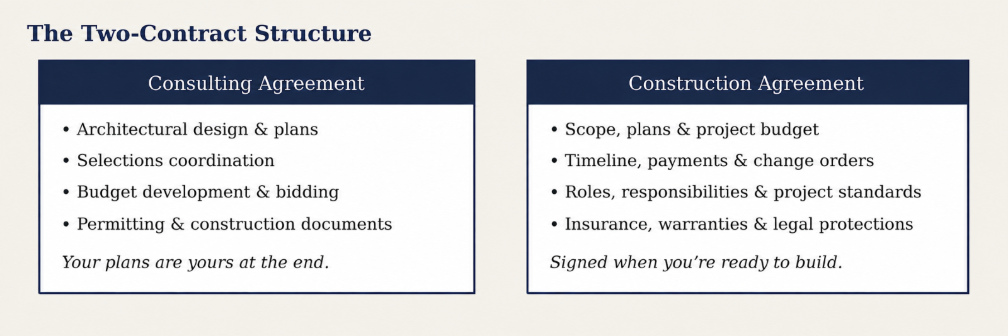
Every agreement with your builder should be in writing, and you should understand the terms that will guide your project before you sign. Your contract should clearly define the scope of work, project budget, payment schedule, timeline, responsibilities of both parties, and the process for handling changes or delays. It should also explain what happens when circumstances affect the original scope, cost, or schedule so you know what to expect throughout construction.
Review these terms carefully and ask questions about anything that is unclear. You should know what is included in your project, when payments are due, how change orders are priced and approved, and how responsibilities are divided between you and your builder. Your warranty should provide the same level of clarity, including what is covered after move-in, how long that coverage lasts, and how warranty requests are handled.
Pro Tip: For a complete breakdown of the provisions to review before signing, read our 20 Key Items Every Custom Home Building Contract Should Include.
The architect plays a central role in shaping your custom home, developing the architectural plans and construction documents that establish the home’s layout, exterior design, and overall direction. They work closely with you to understand how you want to live, your design priorities, and what you want the home to feel like, then translate those priorities into the plans that guide the rest of the project. These plans also provide the foundation for selections, pricing, and many of the construction decisions that follow.
The strongest custom home experiences happen when your builder and architect have an established working relationship — when they speak the same language, understand how design decisions affect what can be built, what it will cost, and how long it will take, and work through those decisions together as the plans develop. At Rivendale, we work closely with an architect who has designed many of our homes over the years and understands our process, cost structure, construction capabilities, and project schedule. For you, that means design options are developed with both your exact vision and target budget in mind from the start.
Meet with a construction lender before purchasing your lot or beginning design to get pre-qualified and understand how much you can finance, how much cash you’ll need to contribute, and how financing fits into your overall budget. A construction lender will explain your financing options, outline how payments will work, and guide you through the loan process.
For 2026, the conforming loan limit for a one-unit home in Austin-area counties is about $830,000; loan amounts above that threshold are generally jumbo loans. Jumbo construction requirements vary by lender, but typically include strong credit, a debt-to-income ratio around 43% or lower, documented assets and reserves, and a 10–20% down payment (Ferrando, 2026). Getting pre-qualified early helps clarify your borrowing capacity, required cash or equity, and estimated payments during and after construction.
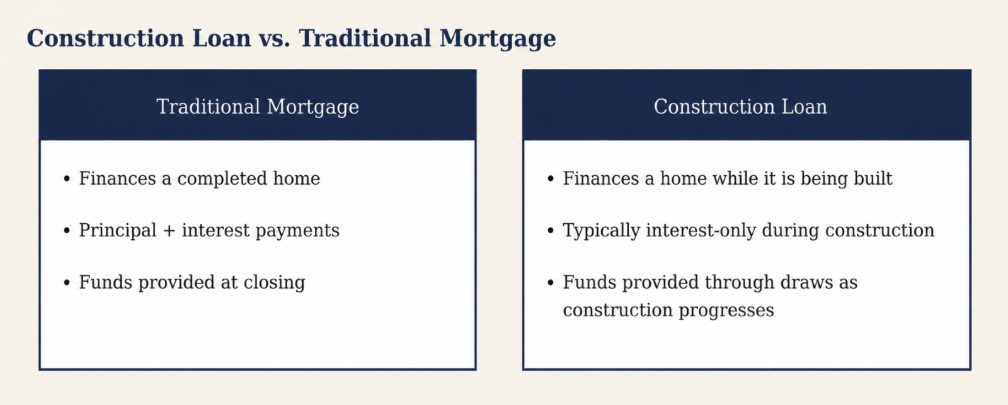
Construction financing works differently from a standard mortgage because funding is provided through a series of draws as construction progresses (Hooper, 2026). Understanding this process early gives you a clear picture of how funds will be distributed throughout the build and what your financial responsibilities will be along the way.
Pro Tip: Ask your builder for construction lender recommendations they have worked with successfully and know to be reliable.
Building a custom home requires close collaboration between your builder, architect, interior designer, lender, and other professionals involved in the project. As you evaluate your team, pay attention to their experience, how they communicate, their approach to budget and decision-making, and how well they collaborate with others involved in the project. Your team should communicate clearly, work well together, and understand how decisions around design, budget, selections, and construction affect one another. Having a team you trust to guide those decisions helps keep the project aligned with your goals, priorities, and budget from the earliest planning stages through construction.
A team with experience working together brings an important advantage to the custom home process. When your builder, architect, and designer understand each other’s processes, they can coordinate more efficiently and better anticipate how design choices may affect cost, timeline, and construction. At Rivendale, we have long-standing relationships with architects, designers, trade partners, and other professionals we regularly work with. That coordination helps keep design and construction aligned, communication clear, and your exact vision at the center of the process.
Do I need to own a lot before contacting a custom home builder?
No. You can begin conversations with a builder while you're still searching for land. Having a builder evaluate potential lots can help you understand factors such as slope, trees, drainage, utilities, impervious cover, and local building requirements before you make a purchase.
How long should I expect the entire custom home process to take?
Construction typically takes 9 to 12 months from foundation to key handover. Pre-construction, including architectural design, engineering, selections, permitting, and financing, takes about 4 to 6 months. The exact timeline depends on your home's size and architectural complexity, your lot, permitting requirements, and how quickly design decisions are finalized.
How do I find more information about construction loans?
Start by speaking with a construction lender early in the process. For additional guidance, you can review Freddie Mac’s overview of construction loans, including how funds are distributed during construction and what happens once the home is complete (Freddie Mac, 2026). You can also explore our custom home budgeting guide and cost to build a custom home blog to learn more about planning the overall investment for your project.
How much does it cost to build a luxury custom home in Austin?
Our recent projects show that luxury custom homes in Austin typically cost between $350 and $600 per conditioned square foot to build, which covers pre-construction and construction costs but does not include the cost of the lot. Where a home falls within that range depends on factors such as site conditions, desired square footage, architectural complexity, finish level, and project goals.
Should I choose a builder who only builds custom homes?
Custom home experience is important, but it shouldn’t be the only factor you consider when choosing a builder. It’s a common assumption that a builder focused exclusively on custom homes will do custom work better. An important consideration in a custom project is budget accuracy, and that depends heavily on how current a builder’s cost data is. A builder who also builds spec homes is spending their own money on every material and trade, on every home, which keeps their pricing knowledge sharp and up to date. That translates directly into more accurate budgets and fewer cost surprises for custom clients.
The distinction that matters isn't spec vs. custom. It's whether your builder has deep custom experience and builds enough homes each year to maintain current, reliable construction cost data. A good question to ask any builder: how many homes do you build a year, and do you build on your own investment?
What’s the difference between spec vs. custom homes?
A spec home is designed and built by a builder before a buyer is involved, with the layout and selections chosen in advance. With a custom home, everything—the floor plan, the finishes, the flow—is designed around your lot, your budget, and how you want to live.
How do I know if my lot is in the WUI?
You can check your property address using the City of Austin’s WUI map (City of Austin, n.d.). Enter your address to see whether your property falls within a designated Wildland-Urban Interface (WUI) area and which zone applies. WUI designation can affect certain building and material requirements, so it’s helpful to confirm this early in the planning process.
We're happy to help whether you already have plans in hand or are just beginning to explore custom homes. If you've purchased a lot, reach out to our team to discuss site feasibility, budget expectations, and next steps. Please reach out at (512) 865-5369.
Chris Peterson is the owner of Rivendale Homes and has overseen the construction of more than 1,000 homes since founding the company in 1994. He is passionate about fostering a culture of exceptional customer service through comprehensive employee training and ongoing mentorship.
A dedicated father of five, Chris enjoys spending time with his family in Austin and on their annual trips, as well as staying active with water skiing and regular workouts.
He is also committed to strengthening the homebuilding industry, having served on the boards of his local homebuilders' association and the Austin Infill Builders Association for a combined 28 years.